Home › Asphalt Pathways, Sidewalks, and Trails
Connect your property with smooth asphalt pathway paving in Jacksonville, FL. We install sidewalks, multi use trails, and bike paths for parks, campuses, and communities. Our team focuses on safe widths, proper slopes, and transitions so pedestrians and cyclists enjoy a comfortable, accessible route.
Precision Asphalt Jacksonville provides professional asphalt pathway paving throughout Jacksonville, FL, Florida and the surrounding area. Our licensed, insured crew delivers safe, clean, on-time work with a free estimate before anything begins. Call (904) 817-0896 or request your free quote.
Durable Asphalt Pathways, Sidewalks, and Trails in Jacksonville
Asphalt pathways, sidewalks, and trails live a hard life in Jacksonville. They sit in the sun most of the year, deal with afternoon thunderstorms, and see plenty of foot traffic, bikes, strollers, and carts. Precision Asphalt Jacksonville builds these surfaces with that reality in mind, not as a side job to our parking lot work.
An asphalt pathway paving project starts with how the path will actually be used. A narrow walking path through a neighborhood common area is designed differently than a shared-use trail that has joggers, bikes, and golf carts. We look at expected traffic, soil conditions, drainage patterns, shade and tree roots, then recommend a pavement structure that holds up instead of raveling or cracking in a few years.
For most walkways and trails in Florida, we use a compacted limerock or crushed concrete base, topped with a hot mix asphalt surface course. On light-use garden paths the asphalt layer may be about 1.5 inches compacted. On multi-use or cart-accessible paths we usually step that up to 2 inches or more and tighten up the base specs. The idea is to match the structure to the load so you do not pay for more asphalt than you need but you also do not end up with edge failures and depressions later.
Because we work only in this region, we also plan around the Jacksonville climate. We avoid placing asphalt on saturated subgrade, which often happens after summer storms, and we choose mixes that stand up to repeated heating and cooling in direct sun. We talk to you about the timing too. Some HOA or facility managers prefer work in cooler months when use is lighter, and we schedule and phase the project so parts of the path system stay open where possible.
How Our Asphalt Pathway Paving Process Works
Good-looking paths and sidewalks start well below the black surface. Precision Asphalt Jacksonville begins with layout and grade checks. We review your plans, or create simple layout drawings if you do not have them, then set string lines and paint marks to show where the edges, curves, and transitions will fall. On sloped sites we pay close attention to cross slope. Too flat and water sits; too much slope and it feels unsafe for pedestrians and wheelchairs.
Next is earthwork and base preparation. We strip off grass and organic soil, then proof-roll the subgrade with a loaded truck or roller. If we see pumping or rutting, we fix it before moving on, either by undercutting soft spots and replacing them with compactable fill or by adding a thicker base layer. For most Jacksonville projects a 4 to 6 inch limerock base, compacted to at least 98 percent density, is our starting point for paths and sidewalks.
Once the base is shaped to final grade, we roll it with a vibratory roller and check it with a straightedge. Any dips get corrected now, because asphalt follows the base. We then tack coat the base with asphalt emulsion if needed to improve bonding, especially on steeper sections or where we are tying into older pavement.
For the asphalt surface, we use a small paver where access allows and hand place in tighter garden areas. We typically use a fine-graded surface mix for pathways so the texture is smoother for strollers, wheelchairs, and bikes. After laying the asphalt slightly thicker than the finished target, we compact it with a steel drum roller and plate compactors at the edges. Joints are luted and compacted so you do not feel a bump where a new section meets an old one.
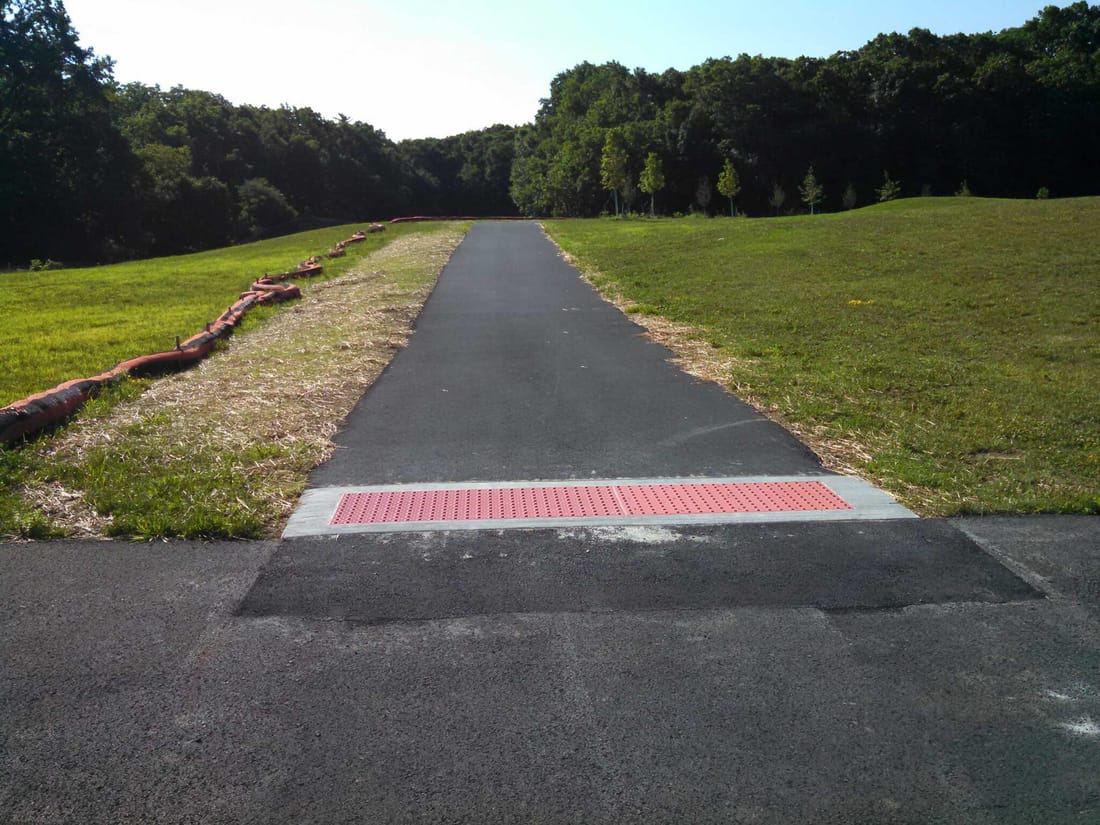
Finally, we handle edges and transitions. On lawn edges we create a slight taper so mowers can ride up without breaking the asphalt. Where the path connects to concrete sidewalks or ramps we grind or feather the asphalt so there is no trip edge. If the project calls for striping, reflectors, or bollards, our crew installs those after the asphalt has cooled and set.
Design Options and Local Considerations for Sidewalks and Trails
Designing an asphalt path or trail in Jacksonville is partly about looks, but it is mostly about function and long-term maintenance. At Precision Asphalt Jacksonville, we walk the route with you when possible. We look for choke points, sharp turns, low spots that hold water now, and heavily shaded areas where roots are already lifting the ground. That walk-through shapes the design more than any catalog photo.
Width is the first key decision. Residential walking paths may be 4 to 5 feet wide, enough for one or two people to pass. For community trails or school campuses, 8 to 10 feet gives room for bikes and pedestrians. On apartment properties and HOA common areas we often recommend wider sections around mail kiosks, trash enclosures, and playground entrances, since people tend to bunch up in those spots.
Curves and intersections matter too. Tight bends can crack at the inside edge where people cut the corner. We soften those curves and add extra base on the inside arc to resist that pressure. At intersections with vehicle drives or fire lanes, we may thicken the asphalt or base in a small apron so delivery trucks do not break the path when they roll over it.
Drainage in Jacksonville’s sudden downpours is a bigger concern than in drier markets. We build at least a 1.5 to 2 percent cross slope into most asphalt pathways so water sheds quickly. In very flat areas we may introduce gentle grade changes and install small swales or drains beside the path. Around retention ponds and marsh edges, we often suggest a slightly higher path elevation than people expect. A couple of extra inches at construction can keep a trail usable when the pond level is up after a storm.
You also have surface and edging choices. Standard asphalt is black, but over time it weathers to a dark gray. For decorative areas, customers sometimes add concrete, brick, or timber edging to create a finished look. We can also prepare the asphalt so a future sealcoat with color additives adheres well if you want a themed look without paying for a full concrete or paver walkway.
What Affects Cost and Common Issues We Solve
Path and sidewalk projects do not all cost the same per foot. Precision Asphalt Jacksonville is upfront about what drives pricing so you can compare bids fairly. The biggest cost factor is access. If the crew can reach the path alignment with a small paver and roller, production is quicker and costs are lower. If everything has to be wheelbarrowed or moved with a mini skid through narrow gates, labor goes up.
Thickness and base type are next. A 4 foot walking path behind homes on firm, well-drained soil can use a lighter base than a 10 foot shared-use trail around a lake that may see maintenance carts and small trucks. More base and thicker asphalt cost more initially but prevent rutting and edge failure. We show you options side by side so you know what you are getting.
Tree roots are another common Jacksonville issue. Live oaks and pines make great shade, but their roots will lift any pavement over time if they are not managed. Before we pave, we identify root zones that are already pushing the ground up. Depending on the situation, we may adjust the path alignment a few feet, carefully prune select roots with an arborist, or build a thicker base layer over a geotextile fabric to spread loads and slow down future movement.
Moisture and soft soils around retention areas or older fill can cause long-term settlement. When our proof-rolling shows soft spots, we typically undercut those areas, bring in better fill, then compact in thin lifts. In some cases we may recommend a stabilization treatment, such as mixing cement or lime into the subgrade, if your budget and soil conditions point that way.
We also tackle issues on existing asphalt paths. If your community trail has alligator cracking in certain sections but is fine elsewhere, we will core sample to see if the base failed or if it is just surface age. For base failures, we cut out and rebuild from the bottom up. For surface-only issues, we may mill and overlay, which preserves your existing grades and curbs but gives you a fresh, smooth surface.
Maintenance, Safety, and Working Around Your Property
Once your asphalt pathways, sidewalks, or trails are in place, a little attention keeps them in good shape. Precision Asphalt Jacksonville usually recommends a first sealcoat in 2 to 3 years, not immediately after paving. The asphalt needs time to finish curing. After that, a fresh sealcoat every 3 to 5 years helps block UV damage and slows oxidation, which is a big factor in our hot Florida sun.
Crack sealing is equally important. Even with good construction, small cracks can appear from minor ground movement or tree roots. If you catch them early and seal them, water stays out of the base and you avoid potholes and edge failures. We can set up a simple annual or biannual walk-through schedule for HOAs, schools, and facility managers to identify and repair small issues before they turn into larger capital projects.
Safety is part design and part maintenance. At corners and drive crossings we can add reflective striping or markings so both drivers and pedestrians see the crossings clearly in low light. For steeper sections, we may adjust the texture of the asphalt slightly or add warning signs if ADA guidelines require notification. During construction, we handle barricades, caution tape, and signage so residents and visitors know which sections are closed and for how long.
Working in active communities takes planning. We coordinate pathway paving schedules to limit disruption to residents, students, or customers. That might mean working in segments, keeping one side of a loop open while the other side is under construction, or doing the noisiest work during agreed hours. Before we start, we provide a simple schedule and map you can share by email or posting so people are not surprised by closed sections.
If you are planning new asphalt pathways, sidewalks, or trails in Jacksonville or need to rehab older ones, Precision Asphalt Jacksonville can look at your site, give you options that match your use and budget, and explain exactly what will happen step by step so you know what you are buying.