Home › Industrial and Heavy-Duty Asphalt Paving
Support heavy loads with industrial asphalt paving in Jacksonville, FL. We design thicker sections and reinforced bases for truck yards, loading docks, and warehouse traffic lanes. Our heavy duty mixes resist rutting and fuel spills, keeping your operations running smoothly on strong, low maintenance pavement.
Precision Asphalt Jacksonville provides professional industrial asphalt paving throughout Jacksonville, FL, Florida and the surrounding area. Our licensed, insured crew delivers safe, clean, on-time work with a free estimate before anything begins. Call (904) 817-0896 or request your free quote.
Industrial Asphalt Paving for Jacksonville’s Hard‑Working Properties
Industrial asphalt paving is a different animal from a basic parking lot. At Precision Asphalt Jacksonville, we design and build pavements that stand up to loaded semi trailers, forklifts, dump trucks, container stacks, and repetitive turning movements that quickly destroy light-duty surfaces.
Here in Jacksonville, many of the industrial sites we work on are near the port, rail lines, the I‑95 and I‑295 corridors, and older warehouse districts on the Northside and Westside. Soil conditions can change a lot from one block to the next, which is why our first step is always a site visit and evaluation. We look at your existing pavement (if any), check for base failures, heaving, ponding water, and rutting, then review how your traffic really moves across the site. That real-world traffic pattern is what drives the design for an industrial asphalt system.
Industrial asphalt paving is all about matching the pavement structure to the loads. A staging yard for loaded containers, for example, needs a thicker stone base and more asphalt lifts than an employee parking area in the same facility. We walk you through which areas on your site need truly heavy-duty construction and where we can save you money with standard or intermediate-duty sections.
Because we live and work in Jacksonville, we also design for local climate stresses: intense summer heat, heavy afternoon thunderstorms, and the drainage demands that come with flat, low-lying land. That means paying attention to slope, inlet locations, and edge details so your new pavement drains instead of holding water that can shorten its life.
How Industrial and Heavy-Duty Asphalt Paving Is Actually Built
If you are planning a new yard, loading dock area, or truck route, it helps to know what the work will look like on the ground. Here is how a typical industrial asphalt paving project with Precision Asphalt Jacksonville comes together.
1) Site assessment and planning: We verify your traffic loads (axle weights and frequencies), turning areas, and any special operations like container stacking or fuel delivery. We also review any geotechnical reports you have and coordinate with your engineer if needed. Together we decide where you need heavy-duty sections and where lighter sections are acceptable.
2) Demolition and proof rolling: For reconstructions, we mill or excavate the existing asphalt and unstable base. Then we proof roll the exposed subgrade with a loaded truck or roller to find soft spots. Any pumping or deflection tells us where undercut and replacement of weak soils are needed.
3) Subgrade and base construction: Jacksonville’s sandy soils can be a blessing if they drain well, but some pockets hold water or have clay seams. We may stabilize the subgrade with lime or cement in those spots or add a separation geotextile. On top of the prepared subgrade we install a graded aggregate base, usually in the 6 to 12 inch range for industrial areas. We place it in lifts, compact with vibratory rollers, and check density so the base will not shift under traffic.
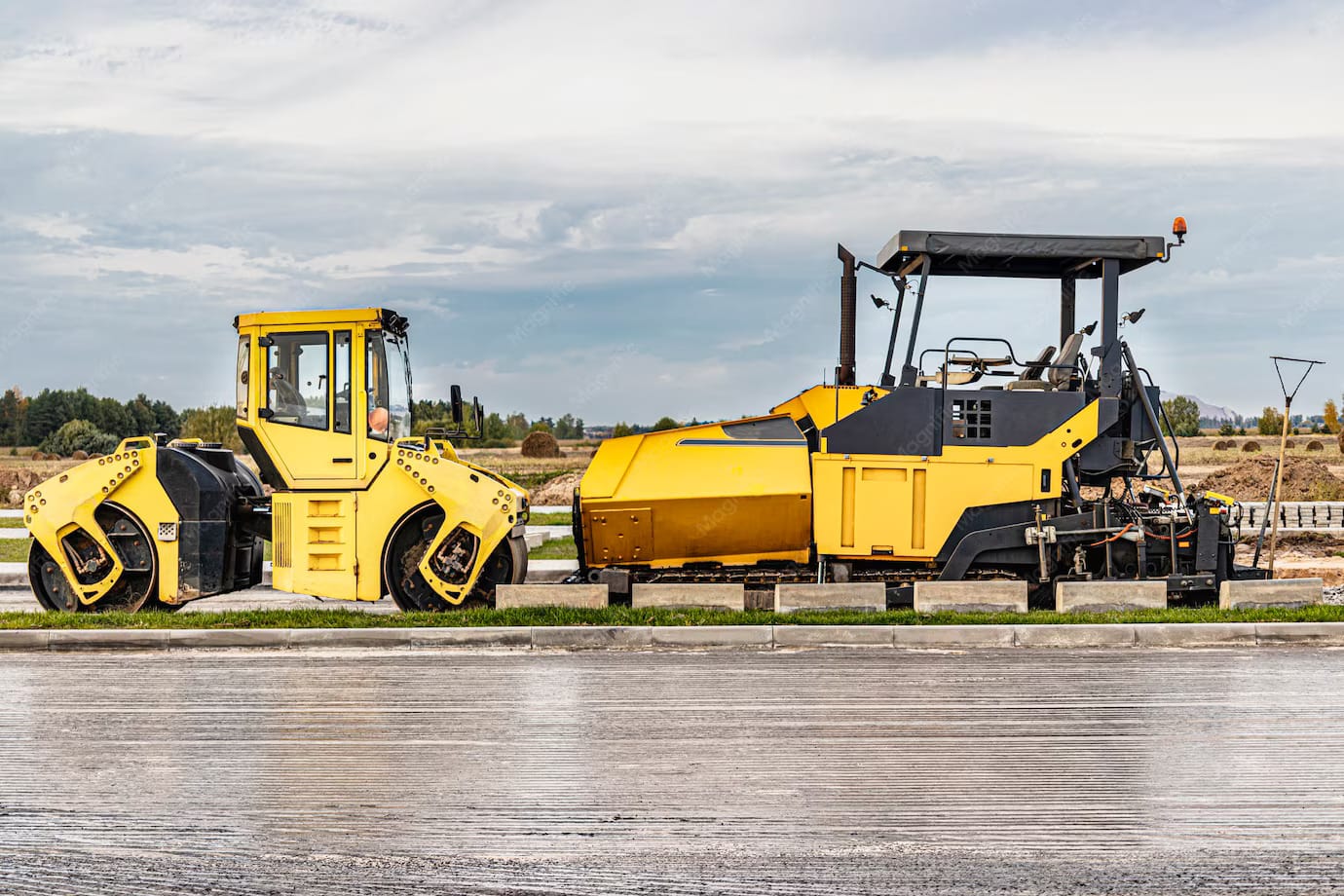
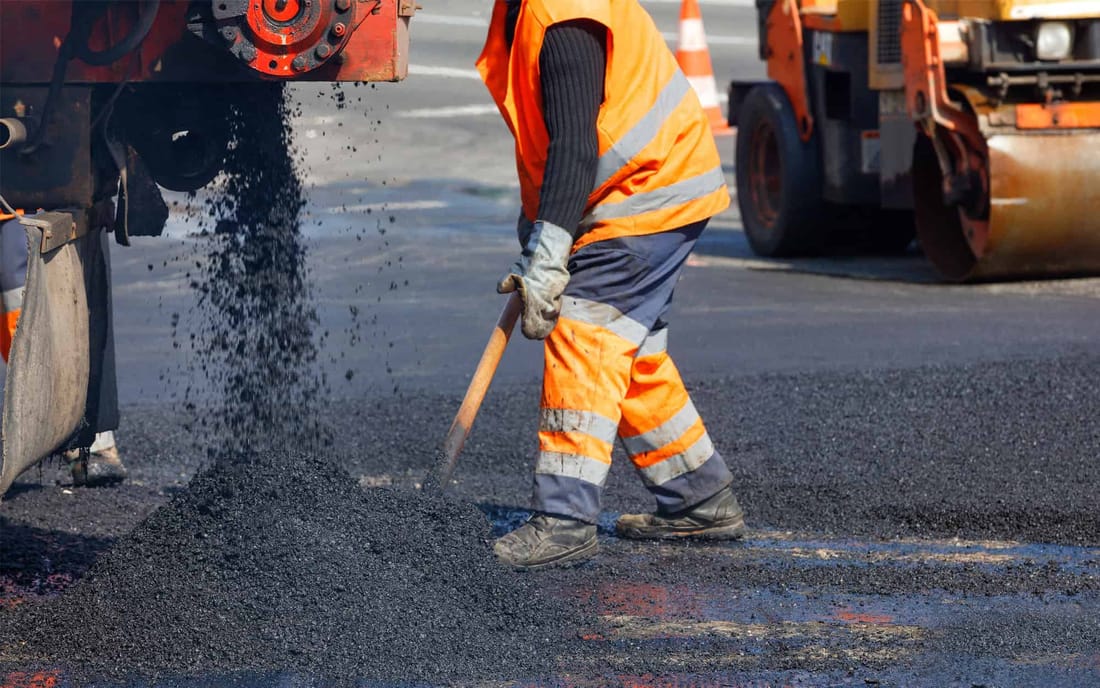
4) Asphalt placement in multiple lifts: For heavy-duty work we do not install all the asphalt in a single thick layer. We typically place a stable base course mix first, then one or more surface lifts. Each lift is laid with a paver, compacted immediately with steel and pneumatic rollers, and checked for smoothness and joint quality. On steep dock approaches or tight turning areas we may specify a mix design with a higher stone content to resist shoving.
5) Joints, transitions, and details: Industrial yards often tie into concrete loading docks, trench drains, and railroad tracks. Those transitions tend to fail first if they are not detailed correctly. We take extra time at these points, using proper saw-cut joints, tack coat, and sometimes reinforced edges so the pavement does not crumble where trucks repeatedly cross from asphalt to concrete.
6) Striping and safety layout: Once the asphalt has cooled, we apply striping and markings that reflect your operations: truck lanes, trailer parking, pedestrian routes, and fire lanes. For night operations we can add reflective markings or recommend LED bollards that work with the pavement layout.
Material Options and Design Choices for Heavy-Duty Asphalt
Not every industrial asphalt project in Jacksonville needs the same material recipe. Precision Asphalt Jacksonville helps you choose among several design options so you get durability where you need it and value where you can.
Mix designs: For most heavy-duty areas we use a dense-graded hot mix with high quality aggregate sourced from regional quarries. High truck traffic zones may use a coarser aggregate mix in the base and intermediate courses to resist rutting. In fuel delivery zones and near loading docks where spills are common, we may recommend polymer-modified asphalt binders that better handle fuel exposure and high temperatures.
Layer configurations: A common industrial section in our area might be something like 8 inches of graded aggregate base, topped with 3 inches of asphalt base course and 2 inches of surface course. Very heavy container yards or frequent crane traffic can require thicker bases or additional asphalt lifts. Employee or visitor parking on the same parcel might only need 6 inches of base and 2 to 3 inches of total asphalt, so we often design multiple pavement sections for one site.
Reinforcement and separation: Where soils are weaker or you have a history of rutting and pumping, we may install geotextile or geogrid between the subgrade and base. This helps distribute loads and reduce long-term settlement, which is important along Jacksonville’s lower-lying, moisture-prone areas near the river and marshes.
Drainage solutions: Industrial asphalt fails early when water has nowhere to go. We can incorporate swales, French drains, or underdrain systems along edges where water tends to collect. In older industrial zones like around Edgewood or the port, we often have to tie new pavement into older storm structures, which may require resetting grates and adjusting rims to maintain correct slopes.
Surface texture and skid resistance: For busy dock aprons and ramps, we can specify mixes and compaction practices that provide a slightly more textured finish for grip, without creating a rough ride for forklifts. In areas where you may use pallet jacks or small casters, we can refine the finish to balance smooth operation with adequate friction.
Costs, Timelines, and Common Problems to Watch For
Industrial asphalt paving is an investment, and understanding what drives the price helps you budget intelligently. At Precision Asphalt Jacksonville we base our pricing on four main factors: thickness and structure, site conditions, access and staging, and production constraints.
Thickness and structure: The more stone base and asphalt your design requires, the higher the material and labor costs. A lightly used warehouse lot might use half the asphalt tonnage of a container yard with heavy stacking. We will usually show you a couple of design options, with estimated service life and cost differences, so you can pick what fits your operation and budget.
Site and soil conditions: If your site has weak or saturated soils, buried debris from old construction, or inadequate drainage, additional work will be needed before paving. This can include undercutting and replacing soft soils, stabilizing with cement, or installing underdrains. Sites along low-lying or filled-in areas of Jacksonville tend to have more of these issues, which we flag early during our assessment.
Access and staging: Industrial facilities often have to stay partially operational while we work. If we must phase construction in small sections, work nights or weekends, or coordinate around specific shipping schedules, daily production slows and overall project duration increases. We plan staging with your team up front to minimize operational disruption while keeping the project efficient.
Common problems to avoid: One of the biggest mistakes industrial customers make is overloading pavement that was designed for lighter use, especially by changing how trailers are stored or routed years after construction. Another is neglecting drainage: clogged inlets and damaged swales keep water on the pavement and accelerate damage. We see this frequently in older Jacksonville yards where layout has changed but drainage has not.
Timelines: A typical mid-sized industrial paving project, such as a 1 to 3 acre truck yard, might require 1 to 2 weeks on-site, depending on weather, thickness, and phasing. Complex reconstructions or sites requiring soil stabilization can stretch longer. We build schedules that account for afternoon storms and summer heat so compaction and joint quality are not compromised.
What Jacksonville Customers Should Know Before Hiring an Industrial Paving Contractor
Choosing the right team for industrial asphalt paving is as important as the pavement design itself. Here is what we encourage Jacksonville facility managers, owners, and contractors to ask before they sign a contract.
Traffic and loading discussion: Make sure your contractor is asking detailed questions about the weights and types of vehicles on your site, how long they sit, and where they turn. If the conversation is only about square footage and not about operations, the design is likely too generic for heavy-duty use.
Soil and base verification: Ask how they will verify that the subgrade and base are strong enough. Will they proof roll with a loaded truck? Will they correct soft spots, or just pave over them? Precision Asphalt Jacksonville builds time into our projects to address these issues instead of ignoring them.
Local references: Industrial sites along Philips Highway, the port, and the Westside experience very different conditions than a small office lot. You should be able to see examples of similar projects nearby and, if you wish, speak with another facility manager about performance over a few years.
Drainage review: Have your paving contractor walk the site with you during or after a heavy rain if possible. That is the best way to see how water behaves. We regularly schedule pre-bid or pre-construction visits around storms when we can, especially in the rainy season, so we design realistic drainage solutions.
Maintenance planning: Before work begins, talk about what maintenance will look like over the pavement’s life. On most industrial asphalt surfaces in Jacksonville we recommend regular sweeping, prompt crack sealing, and periodic inspection of high-stress areas like dock aprons and tight turns. Having a plan in place from day one usually adds years to the life of an industrial pavement.
If you are planning new construction, expansion, or reconstruction of heavy-duty pavement anywhere in the Jacksonville, FL area, Precision Asphalt Jacksonville is ready to walk the site with you, discuss design options, and deliver an industrial asphalt solution tailored to how your facility really works.