Home › Parking Lot Paving & Installation
Give customers a great first impression with expert asphalt parking lot paving in Jacksonville, FL. We design and build new lots, expansions, and full replacements for retail centers, offices, and communities. Our team handles grading, base work, asphalt installation, and striping so you get a safe, efficient lot that drains and lasts.
Precision Asphalt Jacksonville provides professional asphalt parking lot paving throughout Jacksonville, FL, Florida and the surrounding area. Our licensed, insured crew delivers safe, clean, on-time work with a free estimate before anything begins. Call (904) 817-0896 or request your free quote.
Asphalt Parking Lot Paving in Jacksonville, Built for Florida Heat and Traffic
Precision Asphalt Jacksonville installs asphalt parking lots that hold up to Northeast Florida sun, sudden downpours, and stop-and-go traffic. Our parking lot paving and installation work is built around the actual conditions you see every day in Jacksonville, not a generic plan pulled from another climate.
When we look at a new parking lot, we start with how the space will really be used. A small office lot off Southside Boulevard needs different pavement thickness and striping than a busy retail center on Atlantic Boulevard with delivery trucks and daily turn‑over. We design the section (the combination of soil prep, base, and asphalt thickness) to match your actual loads and expected life span.
The heat here is relentless, so we use mixes that resist rutting and softening in high pavement temperatures. We also plan for sudden heavy showers, so we pay close attention to drainage and slope. A good asphalt parking lot in Jacksonville is not just black pavement. It is a surface that stays stable in August, drains in a thunderstorm, and does not ravel or crack early because the base was rushed.
How We Install a New Asphalt Parking Lot, Step by Step
A proper parking lot paving and installation job follows a sequence. Skipping steps is usually why lots fail early. Here is how Precision Asphalt Jacksonville typically handles a new installation:
1. Site evaluation and layout: We check soil conditions, existing grades, and how water currently flows. We look at entry points from streets like Philips Highway or Beach Boulevard, where traffic stacks up, and where pedestrians walk. We then plan drive lanes, parking rows, and islands to move vehicles safely and efficiently.
2. Subgrade preparation: We strip vegetation, soft topsoil, and organic material. If the native soil is weak or holds water, which is common in lower lying parts of Jacksonville, we may undercut and replace with suitable fill or add stabilization. We compact the subgrade in tight passes so it is firm and uniform.
3. Base installation: For most commercial parking lots, we install a graded aggregate base (crushed stone or limerock) in one or more lifts. Each lift is spread, watered as needed, and compacted with vibratory rollers. Typical base thickness in Jacksonville ranges from 4 to 8 inches depending on traffic and soil strength.
4. Proof rolling and fine grading: We run a heavy roller or loaded truck across the base to locate soft spots. Any area that deflects is dug out and rebuilt. We then fine grade to set the exact slopes for drainage, usually a minimum of 1 to 2 percent fall toward drains or the edges.
5. Asphalt placement: We place asphalt with a paver, not by hand, for a consistent mat. Most light duty lots get a 1.5 to 2 inch surface course. Heavier traffic areas may also get a binder course underneath for added strength. We use steel drum and pneumatic rollers to compact to the proper density while the mix is still workable.
6. Joint detail and transitions: We pay attention to tie‑ins at street connections, dumpster pads, and existing pavement. Proper sawcutting, tack coating, and overlapping passes prevent weak cold joints that crack early.
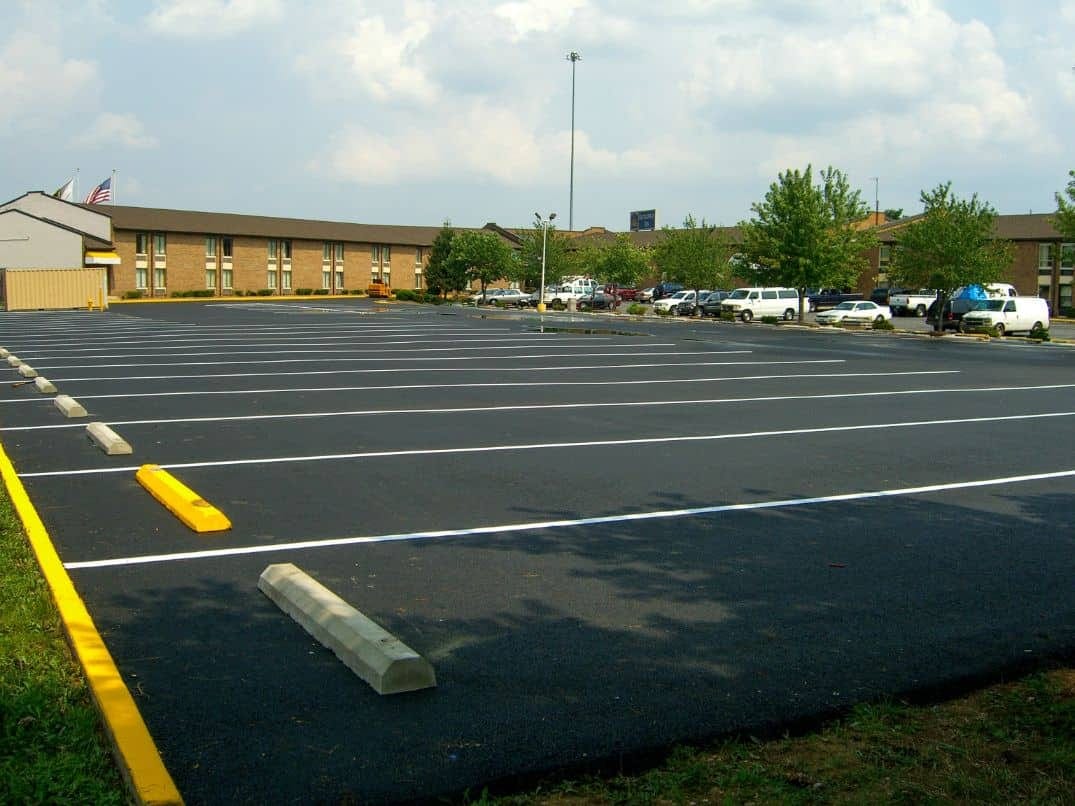
7. Striping and signage: Once the asphalt cools and cures sufficiently, we lay out and paint parking stalls, ADA spaces, directional arrows, and fire lanes according to local codes. We install wheel stops and signage where needed so the lot functions smoothly from day one.
Material Choices, Thickness, and Design Options That Actually Matter
Not every parking lot needs the same asphalt mix or thickness. When Precision Asphalt Jacksonville designs your asphalt parking lot paving, we walk through the options that actually make a difference.
Pavement thickness: For a small office or church lot with mostly cars and SUVs, a single 1.5 to 2 inch surface course over a 4 to 6 inch base is often enough. For restaurants with frequent delivery trucks or small warehouses with box truck traffic, we commonly add a 1.5 to 2 inch binder course and increase base depth. Areas where garbage trucks turn or stop should be built heavier than the general parking field.
Mix types: In our climate, rutting and shoving at stop points are common if the mix is too soft. We specify mixes that hold shape in high pavement temperatures and use proper aggregate gradation so the surface is tight and less prone to raveling under daily traffic and afternoon storms.
Drainage design: Pooling water is one of the main reasons asphalt breaks down early. In Jacksonville this is worse near low spots and near tidal areas where water hangs around longer. We design slopes so water leaves the surface quickly and position inlets or swales where they make sense, not just where is easiest to pave.
Surface finish and markings: Some property owners want a darker, tighter finish for appearance, especially at medical offices or Class A retail. Others prioritize traction in high‑traffic pedestrian areas. We adjust finish techniques, such as final rolling and timing, to hit those goals. We also make sure stall widths, ADA spaces, and fire lanes are laid out to meet Jacksonville and Florida code so you do not get surprise corrections during inspections.
Concrete components: We often tie your asphalt lot into concrete features such as dumpster pads, sidewalks, curb and gutter, and accessible ramps. Placing concrete where static or twisting loads are highest, then transitioning to asphalt for the driving and parking areas, is usually the most cost‑effective combination for commercial sites.
What Drives the Cost of Asphalt Parking Lot Paving in Jacksonville
Costs for parking lot paving and installation vary, but the main drivers are predictable if you understand them. Precision Asphalt Jacksonville is open about how these factors affect your quote so you can plan realistically.
Size and shape of the lot: A simple rectangle is faster to pave than a lot with multiple islands, curves, and tie‑ins. Complex shapes mean more sawcutting, more handwork around edges, and more time for layout and striping.
Existing soil and base conditions: Poor or wet subgrade is common in parts of Jacksonville, especially near marshy or low‑lying areas. If we discover that the soil pumps under the roller, we must remove and replace or stabilize it. That extra work adds cost, but skipping it usually leads to early failure and repeated patching.
Traffic loading: If your lot will see semi trucks, heavy service vehicles, or frequent deliveries, we will recommend thicker base and multiple asphalt lifts. That increases materials and labor, but it also extends life and reduces structural failures in rutted wheel paths.
Drainage requirements: If your property needs additional inlets, re‑grading of ditches, or adjustments to meet stormwater requirements, that work is part of the overall project cost. In areas with strict stormwater rules, like new developments or redevelopments, we coordinate with your engineer so the parking lot elevations match the approved plan.
Site access and timing: Tight sites, night work, or phased paving to keep part of the lot open during business hours can affect pricing. For shopping centers in Jacksonville, we often stage the work in sections so tenants can stay open. This requires extra traffic control, temporary striping, and mobilizations.
Finishes and extras: Line striping complexity, number of signs and wheel stops, concrete curbing, and any decorative elements all add to overall cost. We separate these on our proposals so you can decide what is essential on day one and what can be added later if needed.
Common Parking Lot Problems in Jacksonville and How We Prevent Them
Certain failures show up again and again in local parking lots. When Precision Asphalt Jacksonville designs and paves, we address these issues up front so they are less likely to appear a few years down the road.
Rutting and depressions: In our heat, soft spots show quickly where cars brake and accelerate or where trucks turn tightly. This usually traces back to weak subgrade, thin base, or a mix that was not designed for high temperatures. We combat this by strengthening those critical zones and specifying the right mix for expected temperatures and loads.
Ponding water: You often see shallow puddles after a summer storm that never quite dry. Water sitting on asphalt accelerates oxidation and leads to raveling and potholes. We set slopes during fine grading and check again after paving with a straightedge and visual inspection. If needed, we correct low spots while the mat is still warm.
Edge failures: The outer edges of older lots around Jacksonville often crumble because the asphalt was not supported. For new installations we aim for proper edge support, usually with concrete curb and gutter or adequate shoulder material, so traffic does not break off the sides.
Premature cracking: Early cracking can come from thin sections, poor compaction, or reflective cracking from underlying concrete or old pavement. If we are paving over existing material, we evaluate whether milling, undercutting, or a true reconstruction is the better option instead of placing a thin overlay that will simply mirror existing cracks.
Striping and layout issues: Poorly planned stalls and drive aisles create confusion and near‑misses. When we stripe a new lot, we pay attention to turning radii, loading zones, pickup areas, and ADA access paths so vehicles and pedestrians are separated as much as practical. This reduces congestion and fender benders in busy centers.
What Jacksonville Property Owners Should Do Before Hiring a Paving Contractor
Before you commit to any asphalt parking lot paving contractor, there are several steps that will protect your budget and your property. Precision Asphalt Jacksonville encourages you to do this homework, even if you end up working with us.
Clarify use and traffic: Make a list of who will be using the lot, what types of vehicles will be present, and when traffic is heaviest. Office hours differ from restaurant peaks near Town Center or Baymeadows, and those details affect how we design and schedule the work.
Ask about section design, not just price per square foot: Request that your proposals specify base thickness, asphalt thickness, mix type, and any stabilization. If a quote simply lists a square foot price with no section details, you have no way to compare value.
Confirm drainage planning: Ask the contractor how they will handle water. They should talk about slopes, inlets, and tie‑ins to existing drainage, not just the paving itself. In Jacksonville, ignoring drainage almost always leads to future patching costs.
Discuss staging and access during construction: If you operate a business that cannot shut down, ask how the contractor will phase the work so at least part of the parking remains open. For multi‑tenant sites, this planning is critical to keep tenants satisfied.
Review past projects in similar conditions: Look for completed lots in Jacksonville or nearby with similar traffic and age to what you are planning. Seeing a five‑year‑old lot that still looks good tells you more than any brochure.
Talk about maintenance after installation: A responsible contractor will explain when to consider sealcoating, how to handle small cracks, and which de‑icing or cleaning practices to avoid. Knowing this at the start helps you budget and keep the lot in good condition for years.