Home › Road, Street, and Municipal Paving
Handle high traffic demands with professional road paving in Jacksonville, FL. We construct and resurface streets, subdivisions, and municipal roads with the right mixes and compaction standards. Our team manages milling, base stabilization, and new asphalt to keep traffic moving on durable, well marked pavement.
Precision Asphalt Jacksonville provides professional road paving throughout Jacksonville, FL, Florida and the surrounding area. Our licensed, insured crew delivers safe, clean, on-time work with a free estimate before anything begins. Call (904) 817-0896 or request your free quote.
Road paving in Jacksonville built for heavy traffic and Florida weather
Road paving around Jacksonville is different from laying a driveway or a parking lot. Streets and municipal roads see constant traffic, garbage trucks, school buses, emergency vehicles, and summer heat that softens weak asphalt. At Precision Asphalt Jacksonville, we design and build road surfaces around those real conditions so the pavement holds up instead of ruts, cracks, or flushing out in a couple of seasons.
For local streets and municipal projects, we start with traffic counts, turning movements, and the types of vehicles that actually use the road. A residential cul-de-sac near the Intracoastal needs a different section design than a connector road feeding a distribution warehouse off I-95. We also factor in poor drainage spots, tree roots near the right of way, and existing utilities under the pavement. All of that goes into the mix design, aggregate size, base thickness, and compaction requirements.
North Florida’s climate is another big factor. Summer temperatures on black asphalt can climb well over 130 degrees, and our afternoon thunderstorms can flood low spots in minutes. That combination of heat and water is hard on weak pavements. For local road paving we focus on proper slope (crossfall), enough inlets or curb openings to move water off the surface, and asphalt mixes that resist rutting and raveling in the heat.
The best paving windows for municipal streets in Jacksonville are typically October through April. Humidity is lower, rain is more predictable, and cooler temperatures help asphalt set up properly without tracking or scarring. We still pave in the summer when schedules require it, but we adjust start times, use temperature checks, and stage rollers differently to keep density where it should be.
How Precision Asphalt Jacksonville builds a road, street, or municipal lane
A durable road in Jacksonville begins under the surface. For reconstruction or new road paving, our crew mills or excavates the existing surface to the depth specified by the city, county, or engineering plans. We then evaluate the subgrade. If the native soil is weak, sandy, or pumping water, we stabilize it with lime or cement, or we build up with a thicker base. Skipping this step is why many roads develop dips and soft spots within a year or two.
Next we install and compact the base course, often a graded aggregate base (GAB) or limerock, brought to line and grade with motor graders and checked with laser. Compaction is verified with a nuclear density gauge, not guesswork, to meet the percentage set out in the project specs. A tight, well graded, and fully compacted base is what keeps asphalt from flexing too much under buses and trucks.
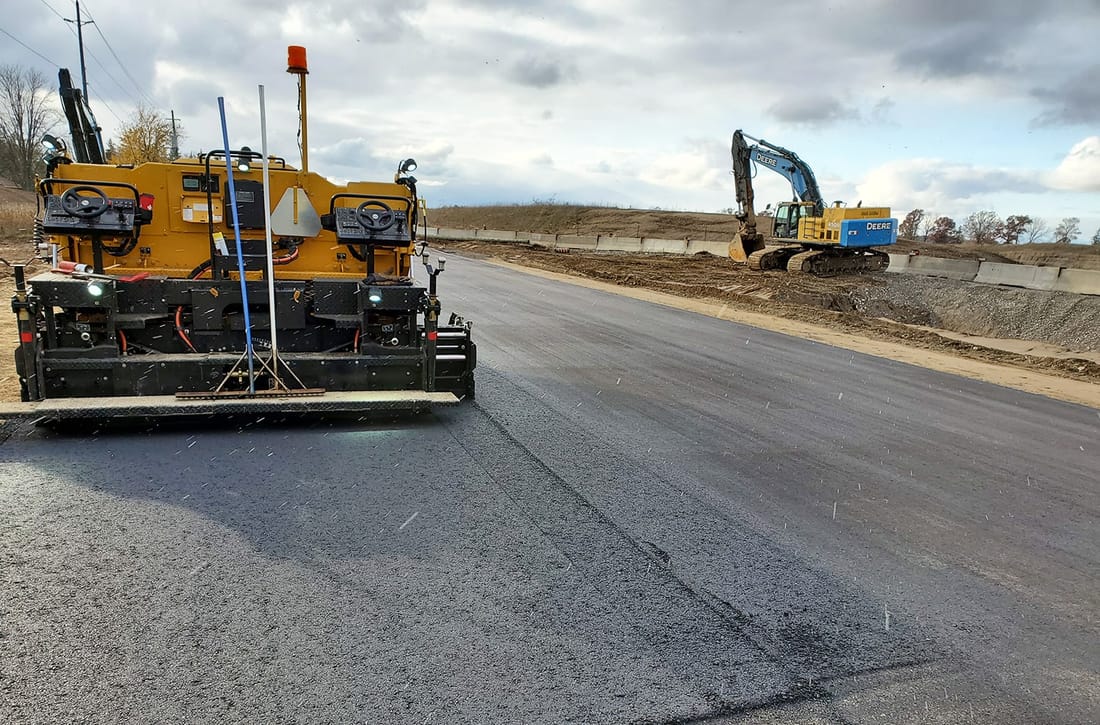
After the base passes inspection, we apply a tack coat to bond old and new layers. Then comes the asphalt placement. For roads and streets we use highway-class pavers equipped with automatic grade and slope controls so we can maintain proper cross slope, smoothness, and curb transitions. On many municipal jobs we place multiple lifts, such as a structural binder course followed by a finer surface course, which gives strength below and a smooth ride on top.
Compaction is done with a combination of breakdown, intermediate, and finish rollers. We adjust rolling patterns according to mix temperature, thickness, and haul time from the plant. On Jacksonville roads near schools or hospitals, where we must work tighter schedules, we may use warm mix asphalt technologies that allow full compaction even when air temperatures or trucking delays might otherwise be an issue. Every lift is checked for density and smoothness before we open the lane to traffic.
Material choices, thickness, and what drives the cost of road paving
The cost of road paving in Jacksonville depends mostly on three things: how we prepare the base, how many asphalt lifts we place, and how much traffic and loading the road must handle. Precision Asphalt Jacksonville walks municipal and private street owners through these choices before work starts so budgets match realistic expectations.
For lighter duty residential streets, we might recommend a single structural lift over a strong base, with a final surface thickness around 1.5 to 2 inches. For bus routes, industrial streets, or roads with frequent truck turning, we will often specify a thicker total asphalt section with a coarser, stronger binder mix below and a finer surface mix on top. While this costs more up front, it usually cuts long term maintenance costs in half or better compared to under built pavements that require constant patching.
Mix design also affects cost. Standard FDOT approved mixes work well for many city and county streets and are usually the most economical. In areas prone to fuel spills, such as near maintenance yards or loading docks, we may suggest modified binders that resist softening and stripping. On roads that need to control noise, such as residential corridors or streets adjacent to multifamily properties, we can use finer surface mixes that reduce tire noise.
Access and phasing influence the budget as well. A straight run of open roadway is cheaper per square yard than a tight neighborhood street with many driveways, cul-de-sacs, and utility lids. Night work, which is often required on busier Jacksonville arterials, adds lighting, traffic control staff, and sometimes higher plant costs. When customers understand how these pieces fit together, they can prioritize where to invest, such as upgrading the most heavily loaded intersections while using standard sections on low volume stretches.
Traffic control, staging, and keeping Jacksonville residents moving
Road and street paving is as much about traffic control as it is about asphalt. In Jacksonville, where many neighborhoods have single entrances or school traffic patterns, poor staging can lead to long backups and safety problems. Precision Asphalt Jacksonville develops a traffic control plan specific to each corridor, following MUTCD standards and any city or FDOT requirements.
On local streets we often work in half widths, keeping one side of the road open while we mill and pave the other, then switching sides. Flaggers and pilot vehicles are used where sight distance is limited. For school zones and bus routes, we coordinate with the school district so buses can get in and out, and we avoid critical drop off and pick up times whenever possible.
For busier municipal roads, night work can be the best option. We set up temporary lane closures with advance warning signs, cones, arrow boards, and, when required, uniformed officers at key intersections. Scheduling is critical, since asphalt plants, trucking, and inspection staff all must be lined up within a tight window so the road is closed for as little time as possible. We also plan for emergency access so fire, police, and EMS can still reach homes and businesses while lanes are shut down.
Communication with residents and property owners is part of the staging plan. Before we start, we provide notice of closure times, parking restrictions, and alternate access. On projects near commercial centers or churches, we stage paving to avoid peak service or business hours. This planning costs less than you might expect, and it usually saves money by cutting down on delays, returns, and rework.
Common road paving problems in Jacksonville and how we prevent them
Jacksonville’s soil, rainfall, and heat create certain predictable failures in roads and municipal pavements. Seeing these issues every week helps Precision Asphalt Jacksonville design and build roads that avoid the same problems repeating every few years.
One common problem is ponding water along the gutter line or in wheel paths. This often comes from inadequate cross slope or low spots where the base was not compacted or graded correctly. We prevent this by laser checking grades before paving, tightening joint construction, and placing the correct cross slope from centerline to gutter. Where necessary, we add inlets or adjust curb elevations so water has a place to go.
Another frequent issue is rutting in the wheel paths on bus or truck routes. This can be a mix design problem, a thickness problem, or sometimes both. In heavy loading areas like industrial parks or near port related traffic, we use stronger mixes with proper aggregate structure, and we add thickness where turning and braking loads are highest, such as intersections and bus stops.
Longitudinal cracking along the travel lanes usually ties back to poor joints or reflective cracks from underlying layers. We address this by planning joint locations, using proper joint compaction techniques, and when needed placing an interlayer or crack relief course over badly cracked old pavements. For municipal agencies trying to stretch their budget, we may use mill and overlay with selective full depth repairs instead of full reconstruction, as long as the base shows no widespread failure.
Before you hire a contractor for road paving in Jacksonville, ask how they handle base evaluation, drainage, joints, and density testing. A low price that skips these steps almost always costs more in the long run. Our approach is to explain what the pavement really needs, match that to your traffic and budget, and put our name on a road we expect to last.